Slugthrowers
OCEANUM ARCHIVES
TECHNICAL RECORD // RESTRICTED CIRCULATION
Designation: KX-400 “Reefline”
Classification: Theoretical Kinetic Personal Defense System
Pattern Authority: Concordat-Compliant
Status: Limited Issue / Controlled Doctrine Asset
“It does not think. It does not decide. It only remembers physics faster than you can.”
ARCHIVAL CONTENT
The KX-400 Reefline was authorized not as a weapon of dominance, but as a response to repeated operational failures in confined, pressure-variable environments. Prior systems optimized for surface engagement demonstrated unacceptable degradation when exposed to salt saturation, hull flex, condensation, and maintenance denial. The Reefline represents Oceanum’s continuing doctrine: conflict, when unavoidable, must be concluded quickly, locally, and without surrendering human agency to autonomous systems.
DESIGN PHILOSOPHY
The Reefline occupies a theoretical boundary space—technology that can be modeled, tested in isolation, and partially realized, but not yet reproduced at scale using pre-Oceanum manufacturing tolerances. It enhances projectile behavior without replacing conventional impulse mechanisms and avoids direct electromagnetic acceleration. Reliability under pressure, seal integrity, and controlled degradation were prioritized over raw output. Lethality was deliberately constrained to prevent escalation beyond immediate tactical necessity.
CONFIGURATION AND FORM
The system employs a bullpup configuration to centralize mass and reduce structural length. Concentrating the power module, assist corridor, and sealed feed systems near the operator’s shoulder reduces fatigue during prolonged operations in currents or low-gravity habitats. The shortened external profile minimizes seam count and flex vectors, reducing failure probability during repeated pressure cycling. Archive measurements intentionally avoid fixed dimensional references; the Reefline is described only as shorter than a surface rifle, longer than a boarding tool.
PROJECTILE SYSTEMS
Reefline munitions are cataloged as Flechette Kinetic Packs rather than discrete rounds. Each pack integrates a dense, non-ferromagnetic flechette core with a transient stabilizing envelope and a sealed interface sleeve. During firing, the projectile passes through a short, non-continuous assist corridor composed of encapsulated field-shaping segments. This corridor reduces yaw and stabilizes initial attitude without functioning as a rail or coil accelerator. The process increases effective performance without extreme thermal or pressure loads. Under submerged conditions, the stabilizing envelope collapses immediately; Oceanum doctrine explicitly rejects attempts to negate hydrodynamic reality.
POWER AND ASSIST FUNCTIONS
The Reefline is battery-assisted, not battery-driven. The keel-mounted power module conditions the launch environment rather than propelling the projectile directly. This distinction remains central to Concordat compliance. The assist system reduces losses rather than adding force, enabling silent operation, controlled thermal behavior, and extended endurance. If seal integrity is compromised, assist functions lock out automatically while baseline kinetic operation remains available.
ENVIRONMENTAL SURVIVABILITY
The Reefline’s survivability is layered rather than absolute. The external shell employs smooth, salt-shedding geometry with step-lapped seams to reduce corrosion and stress concentration. Beneath the shell, pressure-management systems use micro-bladder equalization volumes and passive one-way membranes that permit controlled flooding and drainage without exposing internals. Critical components—including assist corridor segments and electronic assemblies—are fully encapsulated and conformal-sealed. Upon detection of moisture or salinity intrusion, the system enters an Oceanum-safe fail state: assist disengages, manual function persists, and the unit flags itself for armory inspection.
SENSING AND COMPUTATION
Targeting support is provided by the Ballistic Compute Lens, a sealed optic system projecting ghost-reticle overlays derived from deterministic ballistic modeling. The BCL measures range, relative motion, and environmental variables but does not select targets, recommend engagement, or track individuals autonomously. All decisions remain with the operator. Supplementary systems include a pressure-rated optic bridge with purge and thermal stabilization, micropressure sensors embedded in the forward assembly for atmospheric airflow estimation, and directional ejection shrouds optimized for confined spaces.
OPERATIONAL LIMITATIONS
Public documentation avoids numerical performance claims. Internal records note that effective range in air reaches operational relevance only under ideal conditions: stable platform, full power, intact seals, and trained personnel. This range represents a ceiling rather than an expectation. Underwater effectiveness is sharply limited, situational, and explicitly acknowledged as such in training materials.
DOCTRINAL MARKING
Each Reefline bears a standardized inscription near the chamber interface:
INTENT REMAINS HUMAN
This marking is mandatory. It serves as a reminder that no enhancement, computation, or assistive system absolves the operator of judgment or responsibility. In Oceanum doctrine, restraint is not a limitation—it is a safeguard.
END OF RECORD
Unauthorized duplication constitutes a violation.
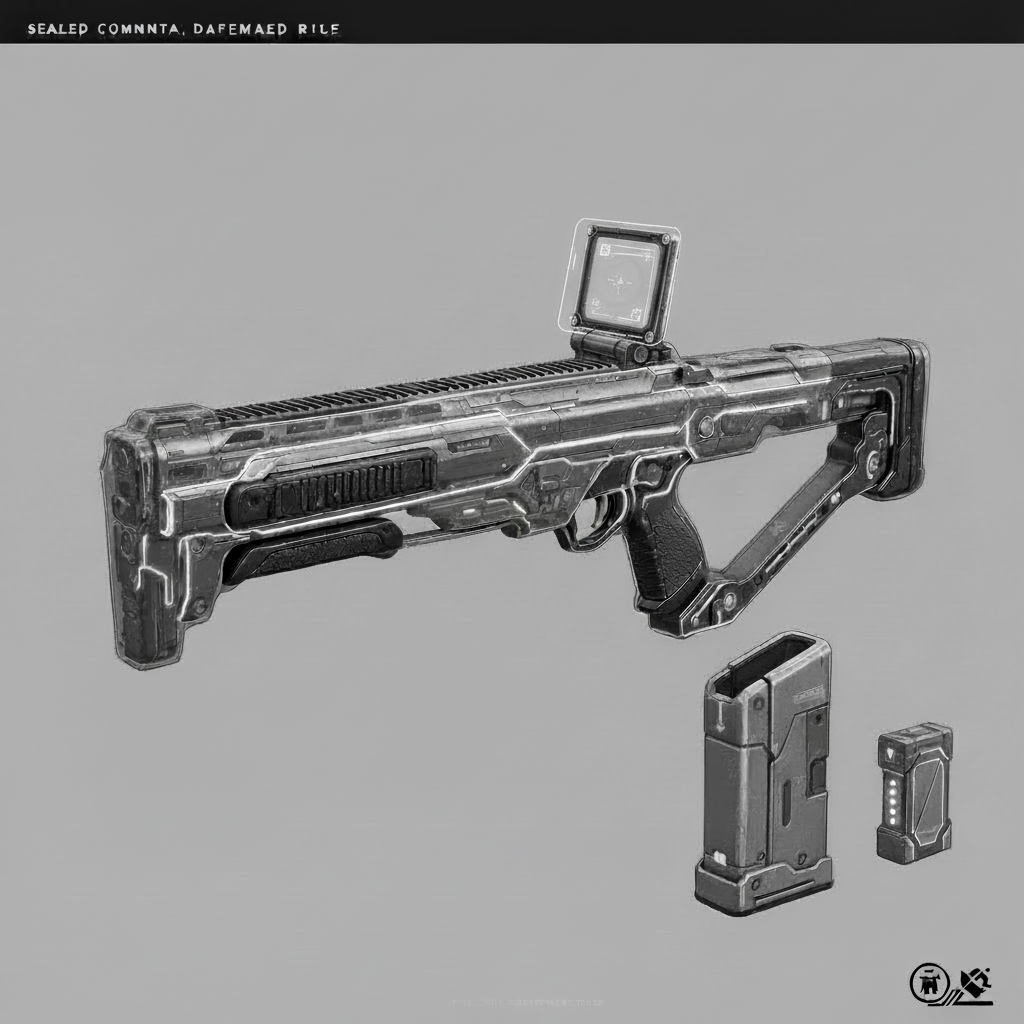
KX 401 Reefline
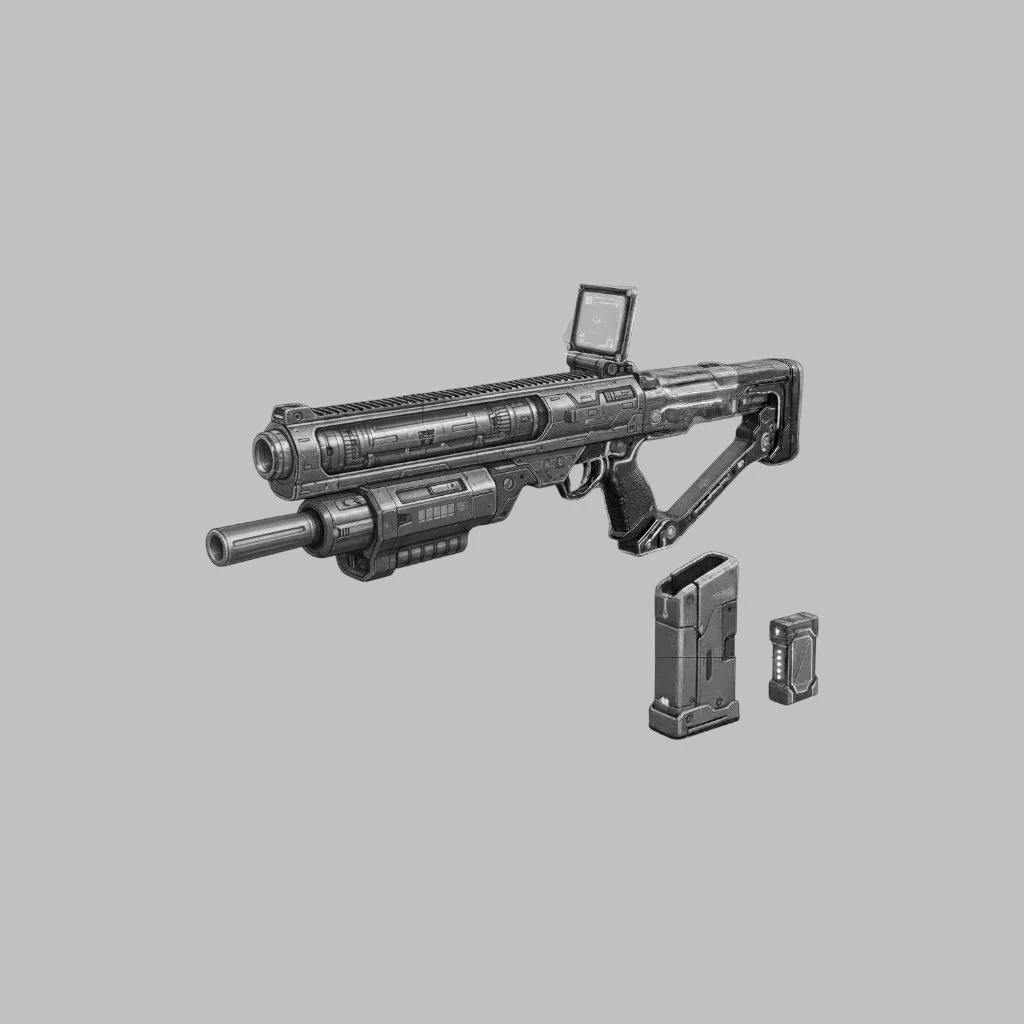
KX 401 “Drone Killer Upgrade